There are faster ways to cross India now. Planes hop you from metro to metro in a couple of hours, and highways are better than they used to be. Still, if you ask people what travel memory they replay most often, it is surprisingly often a train window, not an airport lounge. There is something about a long-distance train ride in India that feels like watching the country breathe in real time.
Even with modernisation and new trains, the railway remains the one network that stitches together deserts, coasts, plains, forests, and high mountains in a single, continuous story. Indian Railways runs over a 68,000 km network and carries roughly 23 million passengers a day. That scale is hard to imagine until you sit in a coach and feel it: the quiet churn of movement, the small towns you never planned to notice, the sudden shift in landscape that no flight path will show you.
In practical terms, it is also easier than ever to plan one. Most reserved travel is digital now, with e-ticketing making up a large majority of bookings. So if you are thinking about train ticket booking for a cross-country trip, or you want to grab train tickets early for a holiday route, the systems are built for it. On redRail, you can search routes, check availability, and book in a few minutes without juggling multiple apps.
The view keeps changing, even when you are not trying
A long drive can be scenic, sure. But highways are designed to avoid friction, which often means avoiding the most dramatic terrain. Rail lines are older, and many were laid when the goal was to connect regions, not to cut travel time to the bone. The result is that trains pass right through the middle of landscapes we usually only see in postcards. You can keep track of your journey details by checking your pnr status ahead of time, which helps you stay updated on coach and seat information before boarding.
Take the Konkan Railway. In about 760 kilometers, it runs along the Arabian Sea, moves through the Western Ghats, and then opens out into paddy fields and coconut groves. During the monsoon, the whole route turns into a moving gallery of waterfalls, mist, and bright green hills. It’s so consistently beautiful that people plan trips just to experience the ride.
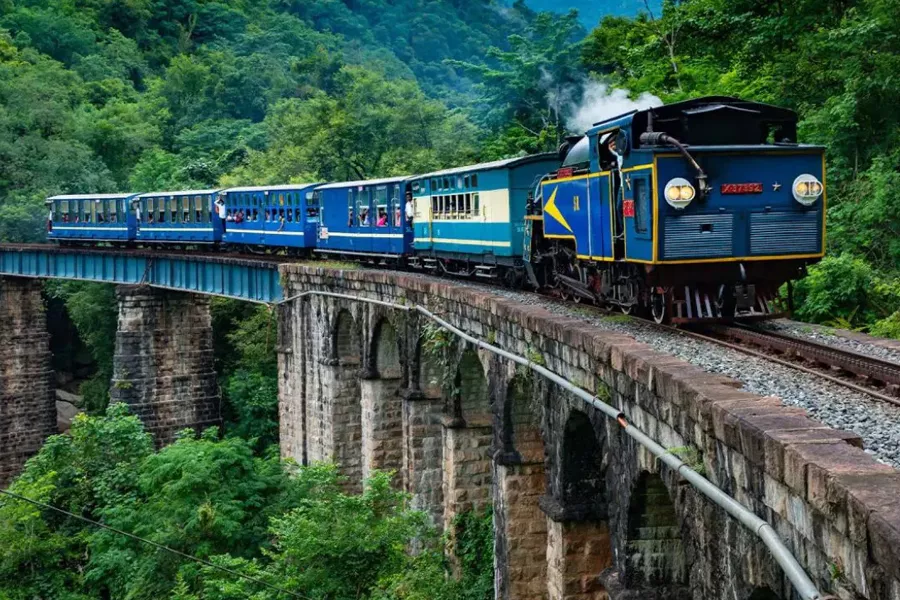
Or look north. The climb from Kalka to Shimla is only about 96 km, but it loops through 100+ tunnels and hundreds of bridges, taking you from warm foothills to cool pine ridges. The Darjeeling Himalayan Railway does something similar in the east, sliding past tea gardens with Kanchenjunga hovering on clear mornings. Both are UNESCO-listed for a reason.
The point is not that every train route is a highlight reel. Some stretches are ordinary. But on long journeys, “ordinary” changes quickly. One night you go to sleep in dry scrubland, and you wake up to river deltas. A few hours later you are cutting through a banana belt. That kind of slow transformation is a rare travel pleasure now.
The train is a front-row seat to Indian life
Scenery in India is not just geography. It is also people. A long train ride lets you see life not as a tourist product but as it is, moving alongside you.
Small stations are the best examples. At dawn in Madhya Pradesh, vendors walk along the platform with poha and chai. In Bihar, you might spot a family sending off a son with quiet, teary hugs. In coastal Kerala, the platform smells of fish curry before you even see the sea. None of this is curated. It is just the country doing its daily thing, very close to your window.
Compartments add to that feeling. You share space, snacks, and stories with strangers for hours. It is one of the few settings left where conversation across age, language, and background still happens without effort. You may not become lifelong friends. But the short-term community makes the journey richer than a solitary drive or a silent flight.
Comfort has improved, but the pace is still human
The stereotype of Indian long-distance trains is crowded coaches and rattling fans. That picture is dated in many parts of the network. Indian Railways has been investing heavily in upgrades, electrification, new rolling stock, and station improvements, while also adding faster services on busy corridors.
But even when trains get faster, they do not lose the one thing that makes them special: a pace that lets your mind settle. If you have ever reached a new city by air and felt disoriented, you know what I mean. Trains ease you in. The hours give your brain time to process distance. By the time you arrive, you feel like you travelled, not teleported.
Sleeping berths matter too. Overnight routes turn travel time into rest time, which is still the best value proposition for crossing big stretches. You save a hotel night, you wake up somewhere new, and you did not have to stare at a steering wheel to get there.
A quick guide to some classic scenic long-distance routes
If you are picking a route for your next break, checking train ticket availability a week or two ahead helps you lock in the best window-side options. Here is a simple snapshot of routes people keep returning to for the views. Durations are approximate and vary by train.
| Route | What You See | Approx. Journey Time | Best Season |
|---|---|---|---|
| Mumbai to Madgaon / Mangaluru (Konkan Railway) | Sea glimpses, monsoon waterfalls, Western Ghats | 8–16 hrs (depending on train) | Jun–Sep (monsoon); Oct–Feb (clear skies) |
| Kalka to Shimla | Tunnels, pine forests, hill villages | 5–6 hrs | Mar–Jun, Sep–Nov |
| New Jalpaiguri to Darjeeling | Tea gardens, toy-train curves, mountain views | 7–8 hrs | Oct–Dec, Mar–Apr |
| Mettupalayam to Ooty (Nilgiri Mountain Railway) | Steep climbs, eucalyptus forests, cloud banks | 5 hrs | Oct–May |
| Guwahati to Siliguri Corridor | Brahmaputra plains, forest edges, misty mornings | 8–10 hrs | Nov–Feb |
These are not the only scenic rides, just dependable ones that show how varied the country looks when you stay on the ground.
Planning the journey without overthinking it
A good long train trip does not need a complicated plan. A few small choices help:
- Pick a window side early. On popular scenic routes, lower berths and window seats go fast. Booking ahead gives you freedom to choose.
- Match the season to the landscape. Monsoons are unreal on the west coast but tough in some flood-prone belts. Winter is great for the north and the plains.
- Pack for comfort, not survival. A light shawl, water, something to read, and headphones for music go a long way.
- Use one reliable booking flow. redRail keeps the process straightforward for reserved seats, and if you are combining your trip with a road leg.
Why this still beats most modern “scenic” travel?
The most scenic way to travel is not always the one with the best viewpoint. It is the one that lets you feel the distance between places. Long-distance trains do that naturally. They show you how terrain changes, how languages shift every few hundred kilometres, how food evolves from one station to the next. They are also accessible in a way that luxury road trips and expensive flights simply are not.
India is too big and too diverse to understand in snapshots. A train journey gives you the long, continuous version. When you finally step onto the platform at your destination, the memory is not just of where you went, but of everything you passed through to get there. That is why, even today, the rails remain India’s most scenic path.